Not just a feature — a whole new way to lubricate.
In 1988, a small lubricant manufacturer in Buenos Aires uncovered a pattern in sugar mills: bearings weren’t failing because lubrication was poor — but because it was fundamentally mismatched to the application, and also hazardous to the environment.
The LAAPSA Timeline
1988
1995
in Brazil and the
Philippines
2008
2014
2018
2026
At very high load and slow RPM, sugar mill bearings operate in a regime where additive grease struggles to hold a protective film.
Slow. Heavy. Wet. The challenge wasn’t the physics — it was the fit. So LAAPSA rethought lubrication for the mill: a synthetic gel, designed to carry multi-ton loads at slow speeds.
In 2008, it came to India through Lubeman Solutions — a partnership with Cenlub Systems, the Indian centralised-lubrication-system specialist. The bearings last three times longer. The ETP load drops to near-zero. The mill house gets cleaner.
We don't sell a lubricant. We sell three crushing seasons of peace of mind.
The world's only R&D facility
dedicated to sugar mill lubrication.
In Argentina since 1988. In India since 2008.
What that means in practice
- Every formulation is tested on full-scale journal bearing rigs simulating real Indian mill conditions: 5RPM–8RPM, multi-ton load, cane juice, bagasse, monsoon humidity.
- Every Indian mill installation feeds back into the next product iteration.
- Adjacent products — OG WP for open gears, Viscopren NTX for food- contact bearings — engineered for the same mill, not the same warehouse.
- Five-year roadmap focused entirely on cane-processing applications.
How LAAPSA works. The principle, not the chemistry.
Ultra-high-viscosity film
Washout resistance
What leaks biodegrades
The numbers behind the claim.
What that means in practice
- OECD 301/B · 28-day biodegradability test · accredited lab certified
- Four-Ball EP weld point · greater than 800 kg
- ASTM D445 · viscosity at 40°C and 100°C
- ASTM D2596 · weld load and load-wear index
- ASTM D92 · flash point Cleveland Open Cup
- ASTM D1298 · density and specific gravity
- ASTM D4048 · copper strip corrosion
Twelve years of peer-presented validation.
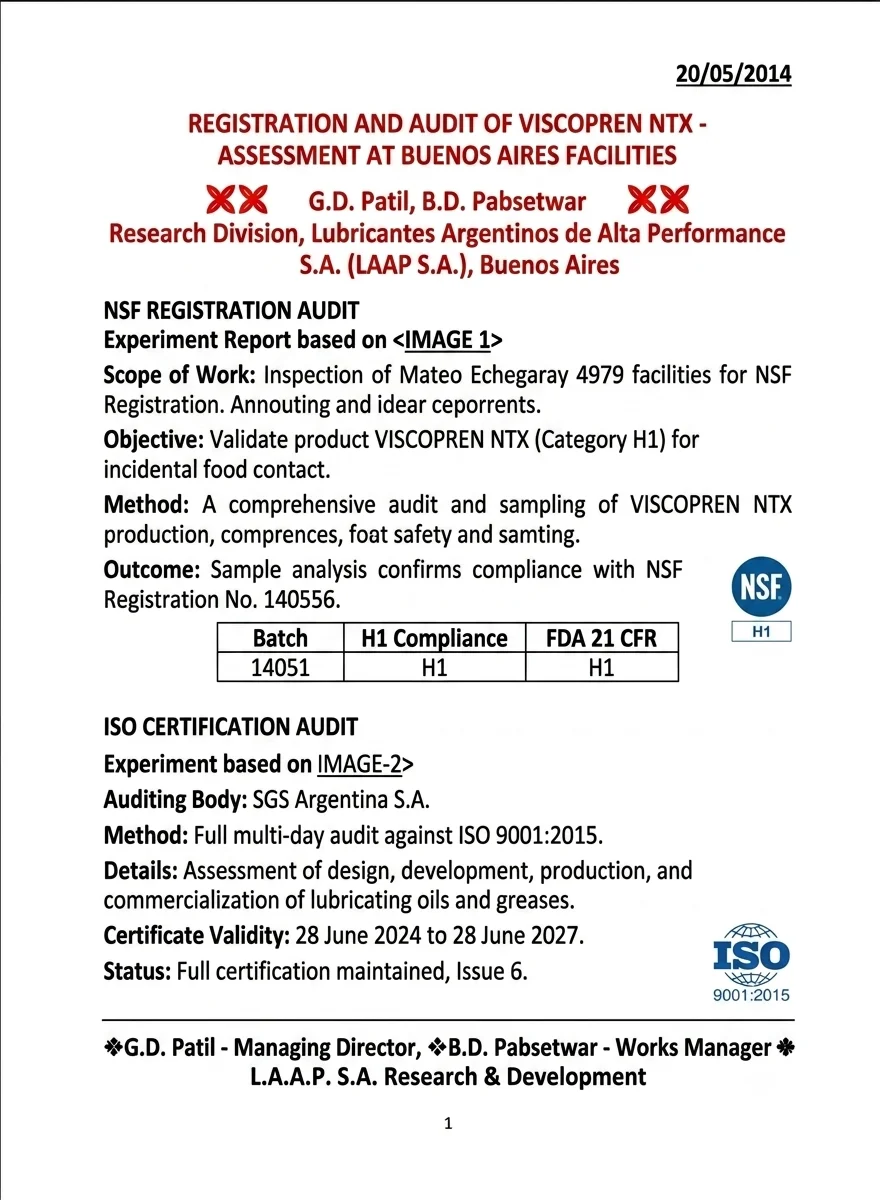
In 2014, Sahakari Khand Udyog Mandal Gandevi published the first peer reviewed paper on LAAPSA’s performance — at the Sugar Technologists’ Association of India conference, Bangalore, 9 September 2014. It’s been in the citation record of Indian sugar mill lubrication ever since.

STAI 2014 paper
Sugar Technologists'
Association of India · Bangalore
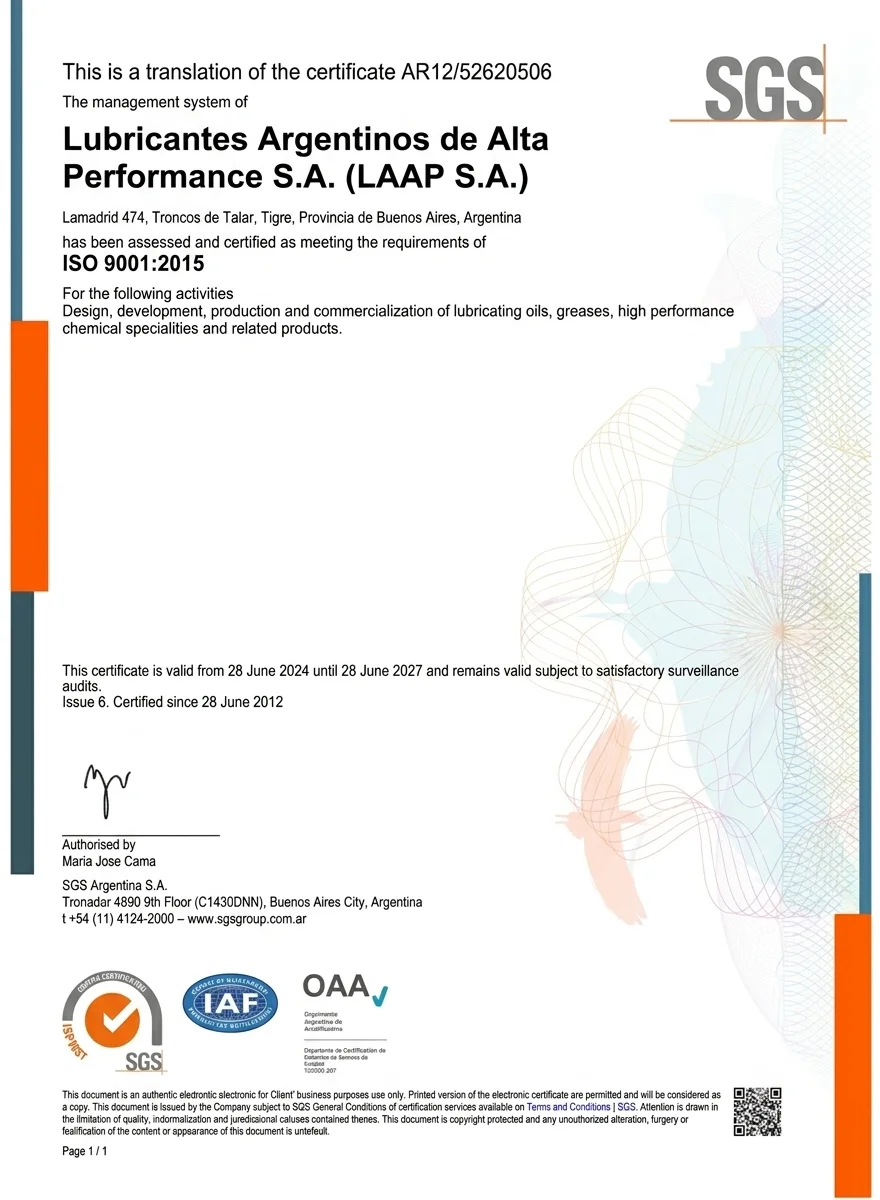
ISO 9001:2000
Quality management system ·
certified manufacturer
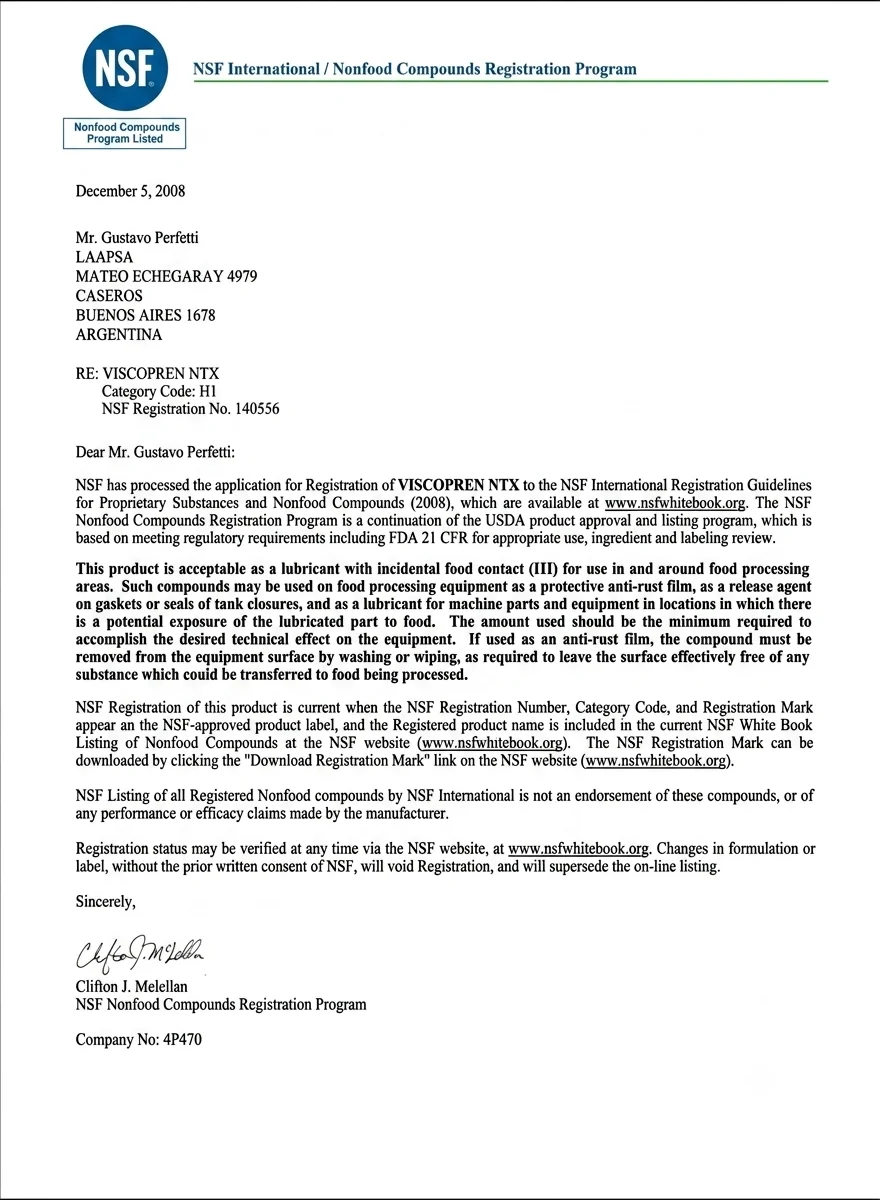
NSF H1 letter
Food-grade compatibility ·
accidental contact permissible
Five principles that shape every decision we make..
- When bearings fail early, the cause is rarely singular. But lubrication is often where the difference is made.
- Per-day cost is the only honest unit. Per-kg pricing measures the wrong thing.
- The lubricant is one part of a system. CLS configuration, dose-feeder sizing, and operator training matter equally.
- Whatever leaks should biodegrade. The mill house ETP is not a waste-management afterthought.
- Every claim needs a paper trail. Test report, accredited lab, source link, named mill. Otherwise it's marketing.
For 40 years, we've watched bearings fail. This is the only product that lets them retire instead..
When we partnered with LAAPSA in 2008, we’d already been installing centralised lubrication systems in Indian sugar mills for two decades. We’d seen every grease. Every additive blend. Every “premium” bituminous oil.
LAAPSA was the first product where the physics matched the application. Not a better version of the old category — a different category entirely. The bearing doesn’t wear because there’s no metal contact. The ETP load drops because whatever leaks biodegrades. The mill house gets cleaner because consumption drops by a third.
The judgment we made in 2008 is the judgment we’d make today.